

Chinese vs European Industry Standards: Comparing Value from TGTY Global Leading Titanium Materials Factory
As global engineering demands become more stringent, understanding how material properties, testing protocols, and compliance frameworks align is essential for industrial decision-makers. Recognizing these cross-border dynamics, Global Leading Titanium Materials Factory operations have evolved to deliver materials that seamlessly integrate Chinese manufacturing efficiency with European quality rigor.
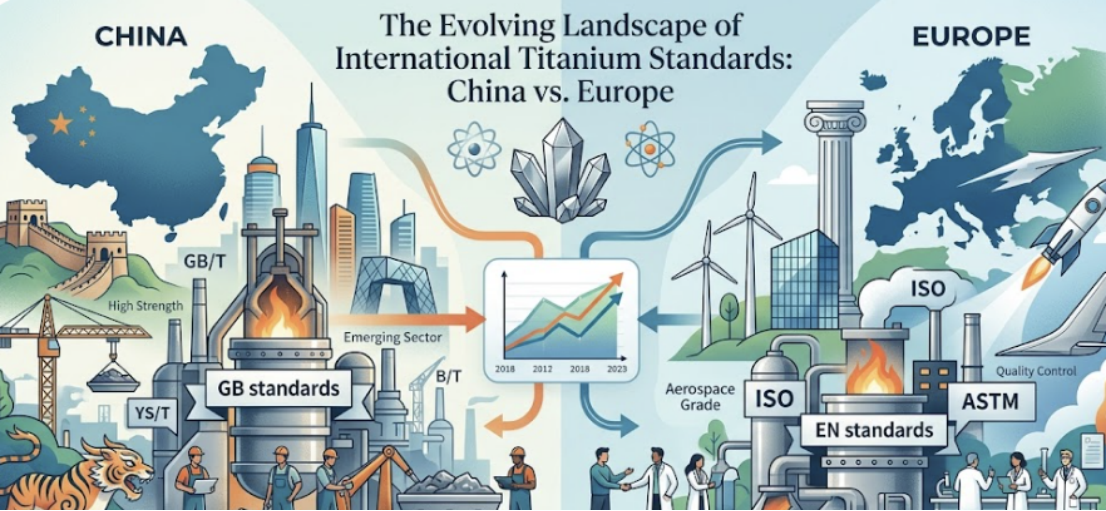
I. The Evolving Landscape of International Titanium Standards: China vs. Europe
The global titanium market has historically operated under distinct standardized systems designed to serve localized industrial bases. China’s primary standard system, governed by Guobiao (GB) standards such as GB/T 13810 for medical applications and GB/T 3621 for titanium sheets, was structured to support rapid industrial expansion and large-scale manufacturing consistency. Conversely, European standards, defined by the European Committee for Standardization (CEN) and integrated with ISO frameworks, have evolved with a strong emphasis on specialized engineering tolerances, life-cycle reliability, and stringent environmental sustainability.
While both standard systems aim to guarantee structural integrity and mechanical reliability, their methodologies differ in scope. The Chinese standard system provides detailed criteria for material classification and cost-effective volume production. The European framework, often intertwined with ASTM standards in cross-border trade, places elevated weight on precise microstructure verification, micro-impurity limits, and mandatory regulatory compliance. Understanding these structural contrasts allows international buyers to evaluate raw material sourcing strategies objectively, ensuring that material selection matches both mechanical requirements and regulatory expectations.
II. Technical Nuances: Grade Designations, Impurity Control, and Environmental Compliance
Comparing Chinese and European titanium standards requires analyzing key technical criteria that directly influence material performance and market access.
Grade Designations and Compositional Mapping
In the Chinese system, titanium and its alloys are designated using the TA, TB, and TC prefixes—where TA represents alpha and near-alpha titanium, TB represents beta alloys, and TC designates alpha-beta alloys (such as TC4, equivalent to Ti-6Al-4V). In contrast, the European market primarily utilizes ISO numerical systems alongside ASTM conventions, such as Grade 1 through Grade 4 for commercially pure titanium, and Grade 5 for the widely used Ti-6Al-4V alloy. Accurate compositional mapping between TC4 and Grade 5 requires careful evaluation, as subtle variations in allowable element ranges can impact ductility and fatigue resistance.
Micro-Impurity Control and Detection Precision
European standards frequently enforce tighter thresholds on interstitial trace elements—specifically oxygen, nitrogen, hydrogen, carbon, and iron. Even fractional variations in oxygen content significantly alter tensile strength and fracture toughness. Furthermore, European testing protocols mandate higher precision in gas element analysis and ultrasonic non-destructive testing (NDT), ensuring that internal voids or inclusions do not compromise high-stress components.
Environmental Regulations and Regulatory Compliance
Beyond mechanical properties, entering European markets demands strict adherence to environmental and chemical safety standards. European directives mandate compliance with REACH (Registration, Evaluation, Authorisation and Restriction of Chemicals) and RoHS (Restriction of Hazardous Substances). Additionally, European procurement increasingly factors in carbon footprint metrics and recycled titanium utilization, placing a premium on sustainable melting processes.
III. Bridging the Gap: Dual-Standard Production and Process Engineering at TGTY
To eliminate technical barriers between Chinese manufacturing capacity and European quality requirements, specialized manufacturers have upgraded their processing infrastructure. As a major industry contributor, TGTY has developed comprehensive dual-standard production capabilities designed to align GB, EN, ISO, and ASTM specifications into a single, cohesive manufacturing pipeline.
To meet European demands for minimal micro-impurities and consistent mechanical behavior, TGTY utilizes advanced vacuum consumable arc melting (VAR) and electron beam cold hearth melting (EBCHM) technologies. Multi-pass vacuum melting refined with precise temperature-controlled forging ensures extreme chemical homogeneity and refined grain structure. By controlling element ranges to the tighter end of permissible spectrums, the facility produces titanium materials that simultaneously satisfy the tensile specifications of Chinese GB standards and the strict purity requirements of European EN and ISO norms.
Furthermore, thermal processing schedules—including solution treatment and aging—are tailored to achieve exact phase distributions. Whether producing seamless titanium pipes, high-strength forged rings, or thin titanium plates, process parameters are calibrated to fulfill dual-standard requirements without requiring secondary processing by end-users.
IV. Quality Assurance, International Certifications, and Full Traceability
Overcoming cross-border compliance challenges requires verified quality management protocols. TGTY has implemented rigorous testing mechanisms at every stage of production, from sponge titanium raw material inspection to final product dispatch.
To ensure total market access across the European Union and international jurisdictions, the production facility maintains key global certifications, including EU CE marking, TÜV Rheinland inspection, and Bureau Veritas (BV) certification. Quality control operations feature state-of-the-art laboratory testing, including optical emission spectrometry, hydrogen-nitrogen-oxygen analyzers, mechanical tensile testing at elevated temperatures, and full-coverage hydrostatic and ultrasonic non-destructive testing.
Traceability remains a fundamental requirement in critical supply chains. Every shipment from the facility is accompanied by inspection certificates compliant with EN 10204 3.1 or 3.2 standards. These material test reports detail complete chemical analysis, heat treatment history, mechanical properties, and non-destructive examination results, offering total transparency from raw titanium sponge to finished product.
V. Real-World Applications and Engineering Value Across Global Industries
The practical value of dual-standard titanium materials is demonstrated across high-demand industrial sectors where material failure is not an option.
In chemical and petrochemical processing, titanium heat exchangers, pressure vessels, and piping systems must withstand highly corrosive environments containing chlorides and organic acids. By producing corrosion-resistant commercially pure titanium (Grades 1 and 2 / TA1 and TA2) and palladium-alloyed titanium (Grade 7 / TA9) according to unified international criteria, global plant operators benefit from reduced downtime and extended equipment lifecycles.
In marine and offshore engineering, high-strength titanium forgings and seamless tubes are utilized for desalinization units, subsea valves, and marine risers. Here, compliance with BV and TÜV standards guarantees resistance to seawater pitting and erosion-corrosion under extreme hydrostatic pressure. Similarly, in energy generation and aerospace component manufacturing, precisely forged titanium rings and bars offer exceptional strength-to-weight ratios and high fatigue resistance.
By offering products that bridge the gap between Chinese standard value and European regulatory precision, TGTY provides global engineering firms with a reliable, cost-effective, and fully certified supply partner.
For detailed product catalogs, technical specifications, and project consultation, please visit the official website at https://www.tgtiindustrial.com/
Bao Ji Special Steel Titanium Industry Co.,Ltd.
Bao Ji Special Steel Titanium Industry Co.,Ltd.
email us here
Legal Disclaimer:
EIN Presswire provides this news content "as is" without warranty of any kind. We do not accept any responsibility or liability for the accuracy, content, images, videos, licenses, completeness, legality, or reliability of the information contained in this article. If you have any complaints or copyright issues related to this article, kindly contact the author above.
